When a local business serves a spread-out area, Google Maps rankings can change from one town to the next. The useful question is not only “Do we rank at our address?” It is “How do we appear across the area we actually serve?”
For one of our clients, a local service business in the Catskills region of upstate New York, we tracked Google Maps visibility across the surrounding area, including communities around Shandaken and Pine Hill.
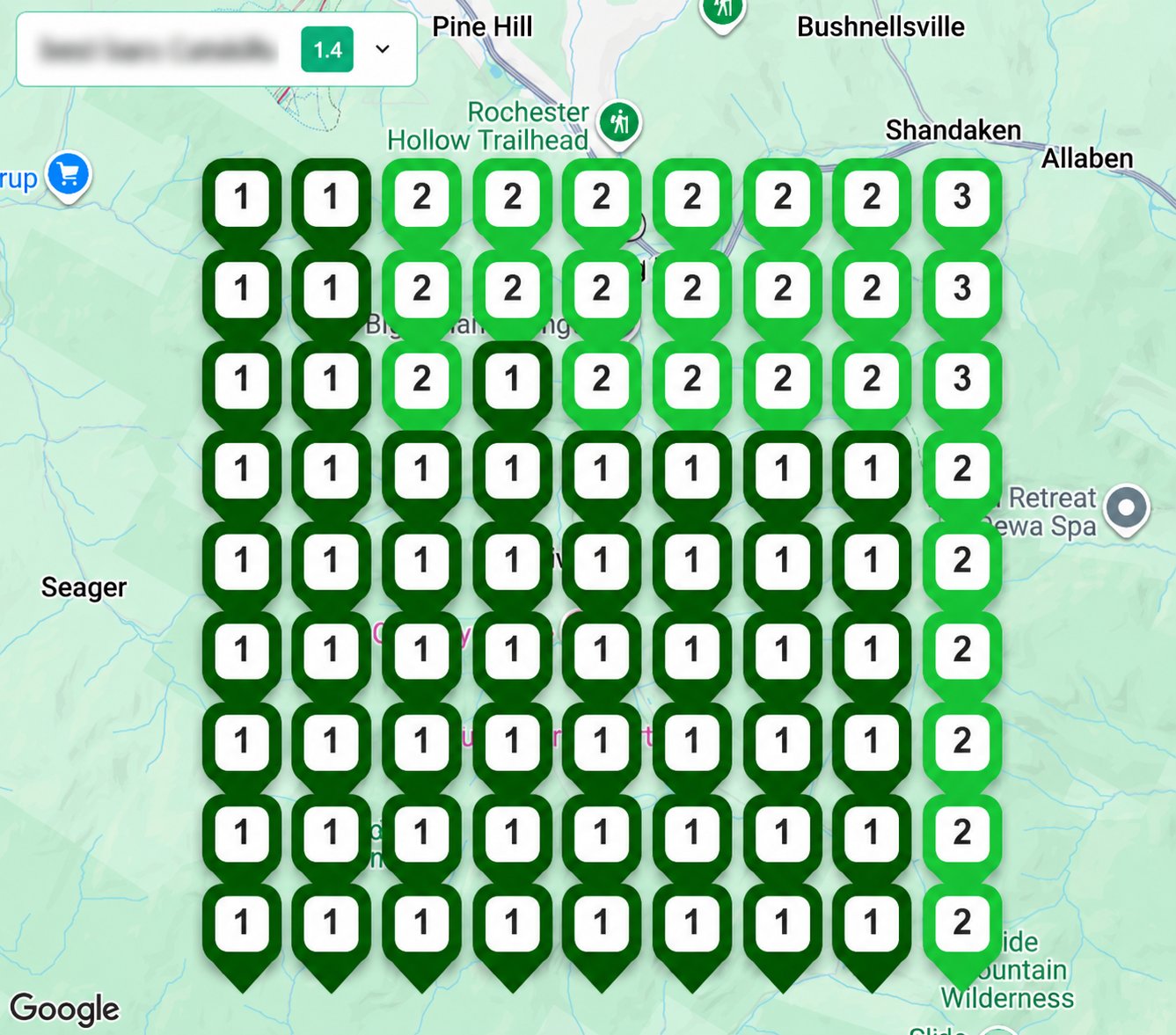
The result is an average Google Maps position of 1.4 across the tracked area, with a #1 ranking at most of the points on the grid.
The client’s name has been kept private.
Google Maps Rankings Across Most of a Catskills Service Area
The Challenge
Rural and small-town service areas do not behave like dense city markets. Searchers may be spread across several communities, and a business can be the clear local choice in one town and less visible in the next.
A ranking grid is a practical way to see that pattern. It shows how a listing holds up across the full area, not just at a single pin on the map.
What We Worked On
Our local SEO approach includes the same core work we use to support Google Maps visibility in any market.
Google Business Profile
The profile is the foundation of a Maps listing. We focus on completing and maintaining the information Google uses to understand the business, its category, and its service area.
Local citations
Consistent business name, address, and phone details across directories help reinforce the listing’s identity.
On-page local SEO
The website should make the business’s location and service area easy to understand, both for visitors and for search engines.
Reviews
A steady, genuine review presence is part of how local listings are evaluated.
These pieces work together. The aim is a listing that search engines can trust and that local searchers can find when they need the service.
The Result
We tracked Google Maps rankings at 81 points across the Catskills area around Shandaken and Pine Hill, New York.
The grid shows an average position of 1.4, a #1 ranking at 55 of the 81 points, a #2 ranking at 23 of the 81 points, and a #3 ranking at 3 of the 81 points, along the eastern edge of the grid.
In other words, the business ranks in the top 3 at all 81 tracked points, and it holds the #1 position at most of them. No point on the grid falls outside the top 3.
Google Maps ranking grid for a local service business in the Catskills region of New York, around Shandaken and Pine Hill. The business name has been blurred for privacy.
1.4
Average position
55 of 81
#1 rankings
81 of 81
Top 3 coverage
The Outcome at a Glance
SEO Metric
Result
Market
Catskills region, New York (Shandaken and Pine Hill area)
Client
Local service business (name kept private)
Tracking method
Google Maps ranking grid, 81 points
Average position
1.4
#1 rankings
55 of 81 points
#2 rankings
23 of 81 points
#3 rankings
3 of 81 points
Top 3 coverage
81 of 81 points
Why This Result Matters
An average position of 1.4 is not a single lucky rank at the business address. It is the average of 81 checks across the surrounding area.
When a listing is #1 at 55 of those points, and no lower than #3 at any of them, it is appearing in the Google Maps pack across the full tracked area. That is the visibility that puts a local business in front of people who are already searching nearby.
The slightly softer results sit along the eastern edge of the grid, where rankings are #2 or #3. Even there, the listing remains in the top 3.
Want to See Where Your Business Ranks in Google Maps?
If you run a local business, or you work with clients who do, a ranking grid is one of the clearest ways to see your current visibility.
WebSkyward offers a free local SEO audit, including a Google Maps ranking grid for your market.